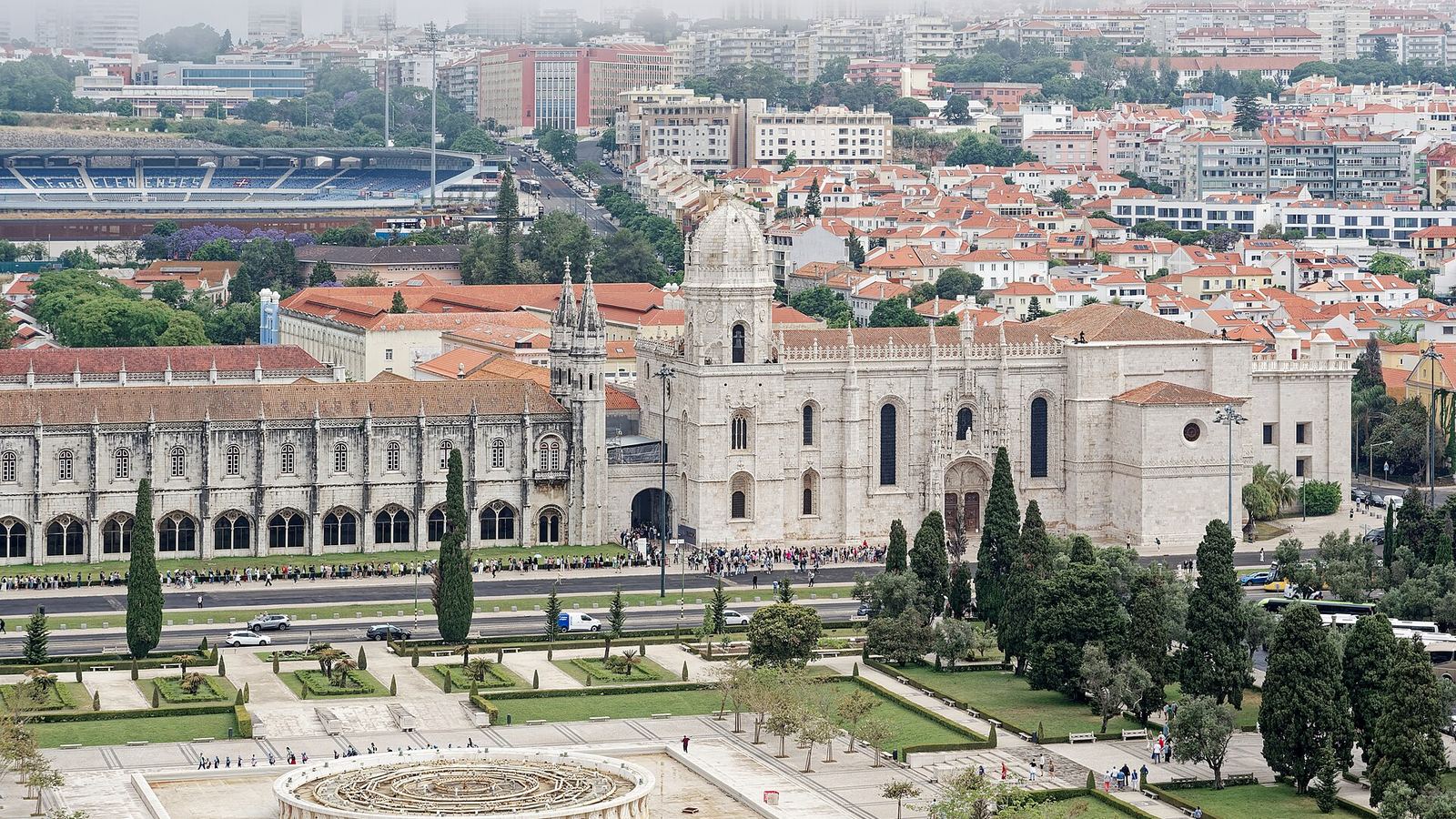
A king's thanks for the sea route to India, and Portugal's national pantheon
When Vasco da Gama returned from India in 1499 with the sea route to the East, King Manuel I celebrated with a monument on the very shore he had sailed from. The monastery, begun in 1501, would take most of the century to complete.
It gave its name to the Manueline style, and became the resting place of Portugal's great explorers, poets and kings.
Vasco da Gama and his crew leave from the Restelo shore for India, after a night of prayer in a small chapel on the site.
King Manuel I founds the monastery for the Hieronymite monks, funded largely by revenue from the spice trade.
Castilho takes over from Diogo de Boytac and shapes the south portal and the cloister.
The earthquake destroys much of Lisbon, but the monastery survives with relatively little damage.
Religious orders are dissolved in Portugal and the monks leave. The building later becomes a school and orphanage.
The explorer's remains are moved to the church, opposite the tomb of the poet Camões.
The monastery is declared a National Monument.
UNESCO inscribes the monastery and the Belém Tower on the World Heritage List.
The remains of the poet Fernando Pessoa are moved to the cloister.
European Union leaders sign the Treaty of Lisbon in the monastery.
In July 1497 Vasco da Gama sailed from Restelo, the beach below Belém, rounded the Cape of Good Hope, and reached Calicut in India in 1498: the first sea voyage from Europe to India.
The spices he brought back made Portugal rich, and helped pay for the monastery.
Vasco da Gama died in India in 1524. His remains came to the Jerónimos church in 1880, where they lie in a carved tomb just inside the door, facing the poet Luís de Camões, who told his story in the epic The Lusiads.
The Manueline style, named after King Manuel I, blends late Gothic structure with Renaissance ornament and the imagery of the sea: twisted ropes, knots, coral, shells, armillary spheres and the cross of the Order of Christ.
In the church, slender columns branch into a single vault like palm trees. In the cloister, every arch is carved with a different pattern, in the warm local limestone called lioz.
The top-rated Belém tour explains the symbols of the cloister. See the tour →
Built in the same years and style to guard the river, it shares the UNESCO listing. Tickets →
Open Tuesday to Sunday. Cloister ticket €18; the church is free.